
Artificial Intelligence
The "Dave" File - a Fossil With Write Access
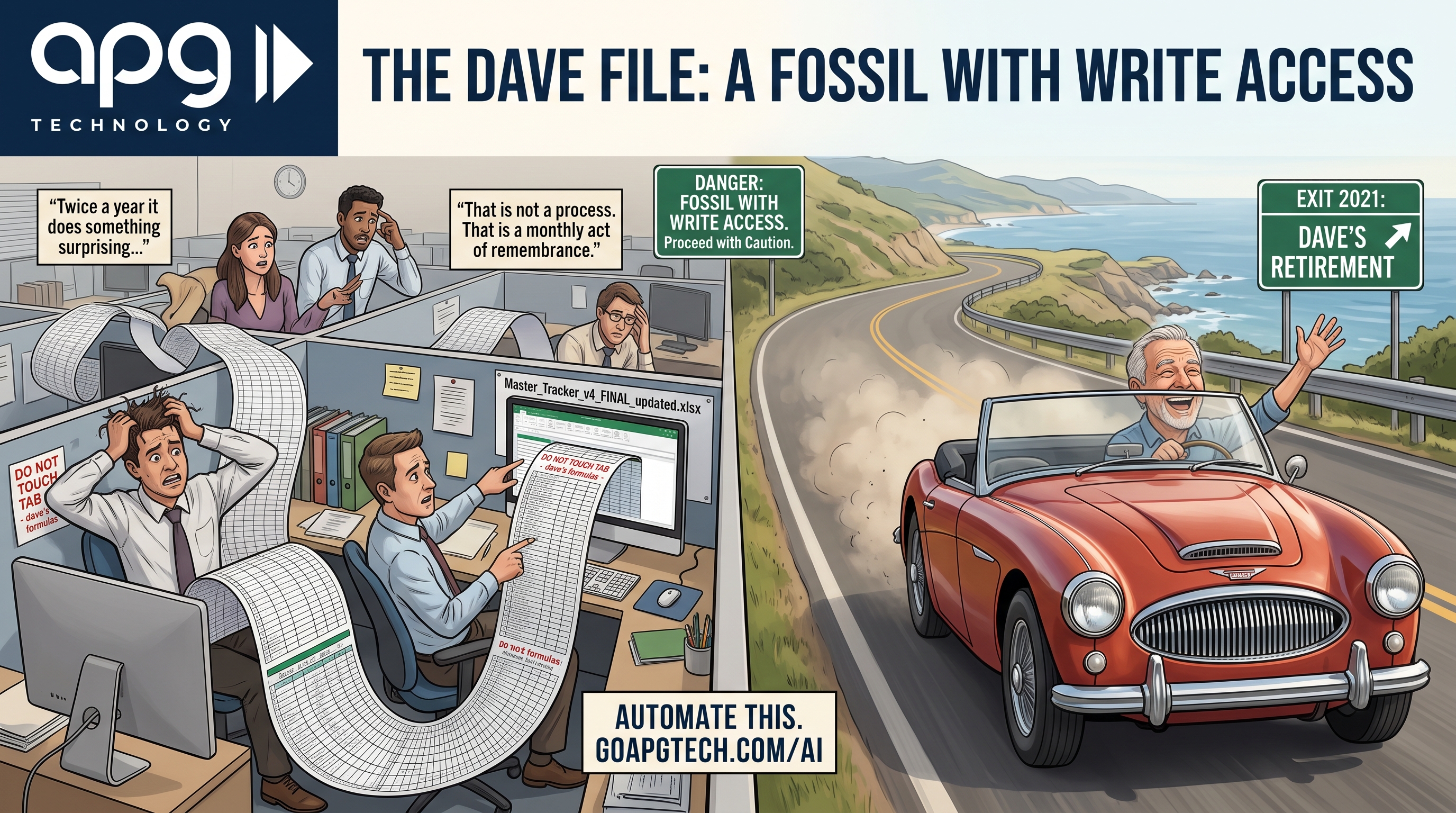
There is a silently running component of your business right now that is holding critical operations together. You likely already know exactly which one it is. It governs a vital part of your daily workflow, and despite its extreme importance to the company, absolutely nobody actually owns it. This phenomenon usually manifests as a sprawling spreadsheet. It often bears a title burdened with conflicting version history, such as Master_Tracker_v4_FINAL_updated.xlsx. Within this file, there is almost always a specific tab that every employee has been explicitly told never to touch. Deep within its architecture, there are columns filled with complex formulas referencing file paths that have not existed since 2022.
Every single quarter, a manager will look at the sprawling mess of data and confidently declare that the company must finally get this process into a real system. Then the busy quarter happens, and the migration is delayed again. That document is no longer just a spreadsheet. It is a fully active production system that nobody officially agreed to build, nobody ever subjected to quality assurance testing, and absolutely nobody is on call to fix.
Sometimes, this operational liability is named after the person who originally built it. In many offices, it is universally recognized as the “Dave file.” Dave might have departed the company back in 2021. He was a skilled employee who solved a genuine problem using the basic tools he had. Dave moved on, but his intricate spreadsheet remained firmly in place. Since his departure, nobody has dared to alter the structure out of sheer fear. Predictably, twice a year the document will produce an anomalous result, someone will state that this is just the way Dave built it, and the meeting quickly moves on.
Dave is long gone, yet his temporary workaround is still quietly running a significant portion of the business. This is a fossil with write access. Leaving a fossil in charge of financial or operational data introduces immense risk. The individual who currently maintains the spreadsheet is blameless, as they are simply keeping the business running when formal software fails to do so. However, they should never be forced to act as the sole backup and disaster recovery plan.
When companies finally decide to replace these manual nightmares, they frequently fall into the trap of the massive enterprise software implementation. This is exactly why the enterprise landscape is currently littered with stalled artificial intelligence initiatives. Research indicates that 95% of enterprise GenAI pilots produce absolutely no measurable impact on the profit and loss statement. Further, over 40% of agentic AI projects will be cancelled by the end of 2027. These failures are rarely caused by the technology itself. They are scope problems. When an organization attempts to build everything at once, nothing is actually live in production by the end of the year.
You can spot the broken processes holding your operations back by looking for six distinct fingerprints.
First is re-keying perfectly correct data into a second system by hand. Second is the copy-paste and reconcile workflow, where an employee acts as a manual bridge between two systems. Third is manual intake. Fourth is the endless cycle of chasing timesheets and approvals. Fifth is the dangerous reality where a process lives exclusively inside one person’s memory, meaning their scheduled vacation breaks the workflow. The sixth fingerprint is a distribution gap, where you have no clean way to receive structured answers back from the field.
The alternative to bloated enterprise failures and unowned spreadsheets is targeted deployment. The mathematics of building smaller are undeniably compelling. In a standard twelve-month period with a set budget, a massive program will spend its time on vendor selection and discovery. That exact same year and budget can yield five separate, fully live microbursts.
Each targeted deployment takes only four to ten weeks to transition to a live production environment. These rapid builds occur on the technology stack the organization already owns, completely avoiding costly platform migrations.
Organizations must stop allowing unowned spreadsheets and ancient workarounds to dictate their operational tempo. The first step is simply identifying the specific manual task that an operations lead performs repeatedly, finds incredibly slow, and completely despises. Once that specific pain point is isolated, the fossil with write access can finally be retired.